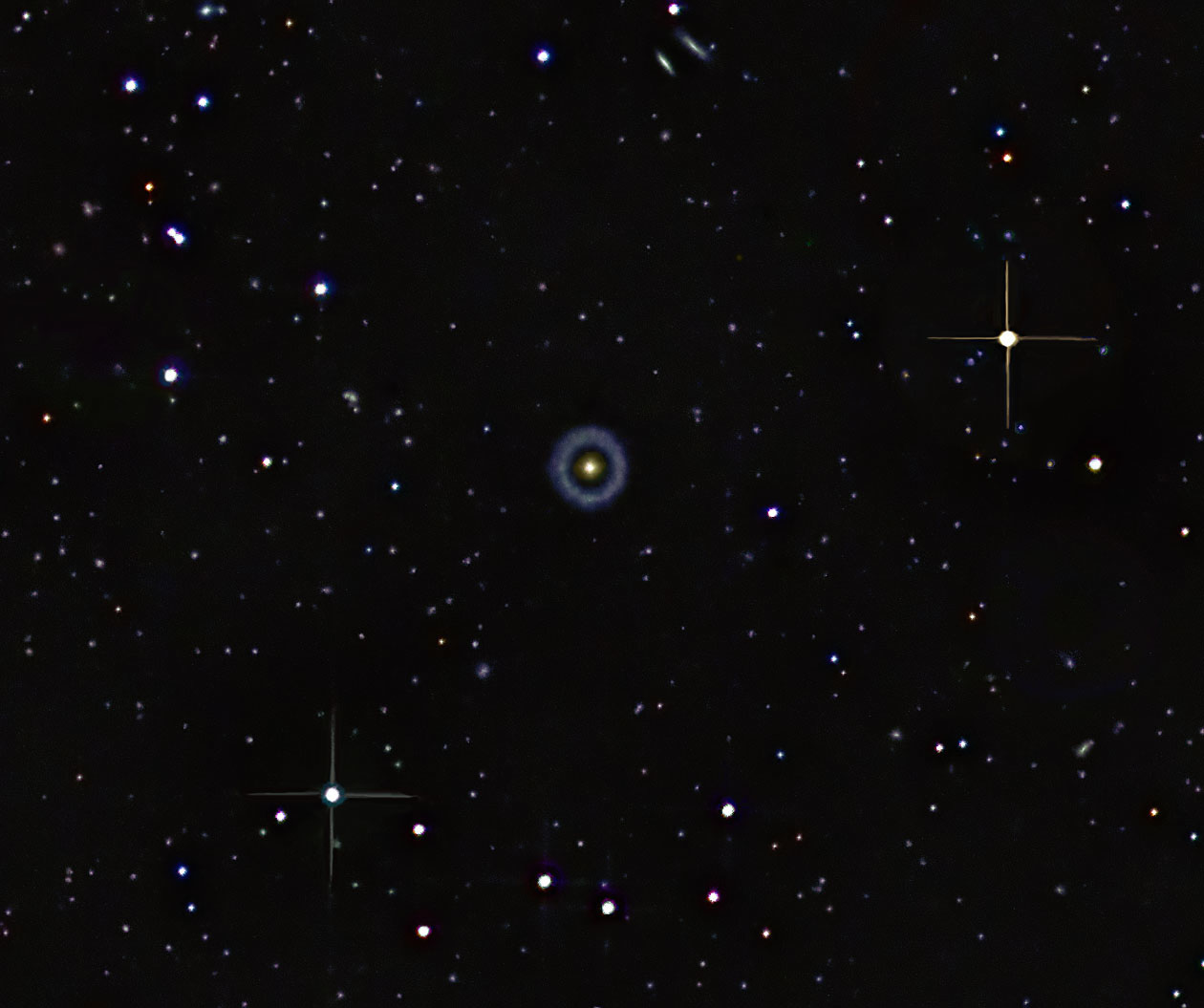
This interesting object was discovered by Arthur Hoag in Serpens in 1850. It lies about 600 million lyrs away.
Originally thought to be a much closer planetary nebula, further study showed it was a distant ring galaxy. However, there is no sign of an intruder, normally associated with a ring galaxy. Thus the basis for the ring remains a mystery. The latest explanation stretches the imagination. It implies that the core is a really ancient elliptical galaxy that accreted neutral hydrogen gas from the early universe, and the ring was a result of that.
It is only somewhat larger than the Milky Way at around 121,000 lyrs in diameter. However, it contains over twice as many stars. This makes it an inherently bright object, allowing us to capture some detail in the outer ring, despite the enormous distance.
PlaneWave 12.5″ Astrograph with ZWO ASI 6200 camera, Astrodon filters and ASA gearless DDM-85 mount. F/8 LRGB (34/8min L, 10/8min RGB each, all 2×2 bin).